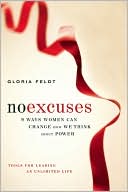
I met Gloria Feldt at an 85Broads event not long after I first left corporate America. I admit to being a bit in awe that I was getting to eat breakfast with this nationally renowned activist sitting across the table from me. I'm still in awe, but what I discovered that morning is that Gloria is as real as the rest of us. She's powerful, she's passionate, and she knows her stuff. A teen mother from rural Texas, Gloria served as president and CEO of Planned Parenthood from 1996-2005. Today she continues to work towards the betterment of women's lives as an independent commentator on women's issues, politics, media and leadership. She teaches at Arizona State University and serves on the board of the Women's Media Center. Her must read book, No Excuses, 9 Ways Women Can Change How We Think About Power has just been released in paperback.
When given the opportunity to sit down and chat with her I was wise enough to accept. I am honored to share with you my recent conversation.
A key concept in your book is about changing the meaning of power for women. Can you elaborate?
Women resist their power in part because we have borne the brunt of the most negative aspects of power for millennia. Power has been defined as the power over something or someone. I urge women to redefine power in their own minds as the power to—power to accomplish good things in this world, power to thrive as an individual and the power to help others, to make life better fro yourself, your kids, your community, your world.
Power over is from Mars. Power to is from Venus. Power over is oppressive. Power to is leadership. See what a difference it makes to define your terms?
I like the Mars and Venus analogy!
The idea of a powerful woman is still a frightening prospect to many men. And to some women. Why in 2012, do you think that still is?
Perhaps you have seen the old Dilbert cartoon: “Change is good. You go first.” Men who are insecure may fear the profound changes that have come from the moves to equalize gender power that you and I regard as simple justice. This is because they hold the old, outdated “power over” hierarchical model of power in their minds, as opposed to the expansive “power to.”
Some women might also fear loss of the comfortable safety of rigid gender roles, and the freedom from responsibility to make their own choices.
You are one of the most well-known and respected feminists out there. How would you define being a feminist today? Is the definition any different than how you would have defined one in 1972?
Thank you !
The fact that sexism remains rampant in media and cultural norms if not laws should tell us that the job of feminism isn’t finished. Nor are we post-anything. But we are in a new phase.
Twenty or thirty years ago, women might have thought they had to become men (metaphorically and in their behaviors and even dress) to succeed. Today, it is clear that the world needs what women have to offer--and women are more comfortable being authentically who they are. We learn and get stronger in the doing.
Feminism has become a dominant social value. Who in 2012 would dare say that girls shouldn’t be educated and aspire to be the CEO rather than the secretary? I believe this is an amazing moment for women, a hopeful and historic moment—if we make it so. It’s time for women to step up, stand in the power they have, and lead their own dreams. And to understand that change won’t happen by itself. Just because there’s a trend doesn’t mean it will continue without conscious action.
For example, women’s numbers in Congress went backward in the 2010 elections because women failed to step up and support those who won in swing districts in 2008. That’s what happened after 1992, the last time an election was dubbed “the year of the woman.” In 1994, those women who had tipped the scales stayed home, and we got the Gingrich revolution and many steps back in women’s equality. The 2012 election is upon us and it’s a new opportunity for us to make it The Year of the Woman. Will we do it? The answer is in our hands once again. That hasn’t changed.
To me, feminism is social justice, and I wouldn’t change the definition.
In your book you argue that nobody is keeping women from parity except themselves. Yet recently we’ve seen a renewed effort on the part of a segment of our population to quell our reproductive and health care rights. Can you offer your insight?
I’ve been thrilled to see women break open so many doors during my life, and my decades of activism. But at the rate women are going, it’ll take 70 years to get to parity-and not just in politics! Women hold only 18% of top leadership roles at work too--and that’s not fair, or good for men, women, a balanced family life, or even companies’ return on investment according to McKenzie and Company’s analysis. Yet in spite of cultural barriers that arguably do remain, from the boardroom to the bedroom, no law or structural barrier is holding us women back now, except ourselves. It is easier to become co-opted by a little success and not hold out for the whole package. Sometimes it is even easier not to have choices. But is “easy” the same as fulfilling? Not to me.
There are many reasons --external barriers of discrimination and internal barriers of fear and insecurity--but there are no excuses any more. The doors are open; we have to walk through them.
For example, in politics, women can now raise money as well as men, are more trusted by the voters, and are clearly as capable of putting together strong campaigns. Still, women candidates face media sexism and scrutiny that can be daunting. Hillary Clinton’s cackle, cankles, and cleavage for example. When did you hear a media commentator say about a male candidate that he couldn’t win because voters wouldn’t want to watch him age?
And what about Rush Limbaugh’s latest outrageous, sexist statements about a young women who merely asked to state her opinion about the need for insurance coverage of contraception?
This is hardly new. The opposition to reproductive rights is what it has always been—a desire to control women’s lives through controlling their bodies and their sexuality. The abortion issue has always been just the tip of a much larger ideological iceberg. As we can now see clearly, the opposition also extends to contraception which most people thought was an entirely settled matter, since 99% of Americans use contraception at some time in their lives.
Even with all that, the only way to make the change is to make the change. Hillary did that and as a result it is becoming increasingly clear to people that leaders can have breasts and wear turquoise pantsuits. When women run they are now as likely to win as men, but young women are 50% less likely than men to even think about running for office.
So we have to take the leap. You can’t win if you don’t run. You can’t get the job if you don’t apply or the salary raise if you don’t ask. You might not always get what you ask for, but that is one of the things we need to learn. Being told “no” isn’t the end of the world. Try again.
Many say the Feminist movement, has been invigorated because of the banter and rhetoric of people like Rick Santorum and Rush Limbaugh. Do you agree?
Yes, it has been invigorated, but in the breech. It’s great to get angry and get active to oppose something, but we are missing a big, bold agenda to aspire to. I hope that the energy generated by the Limbaughs and Santorums will be used to fuel the next wave of feminist legislation and advocacy for positive changes in society, to “fight forward,” not just to “fight back.”
Personally
my blood starts to boil when I see the pictures of these all white, all male
juries discussing birth control. It’s reminiscent of the Inquisition and the
Salem Witch trials. I get so crazy
I can barely breathe. What power tool or tools would you suggest women like me
can implement in those moments?
I’d say Power Tool #2, “Define your
terms—first before others define them for you” is hardest but the most
important here because we have yet to define power on our own terms. We react
rather than setting the agenda. I think the current spate of legislation aiming
to be equally in-your-face to anti-choice legislators—like requiring a man
seeking Viagra to bring his partner in to attest he is impotent and give
permission—are one sign that some people are waking up to this.
And then Power Tool #7: “Create a movement”
to get together with your sisters and supportive brothers to make the change
you want and leave the retrogrades in the dust.
One
of my favorite power tools is “Know Your History.” With women’s history not
being taught in the schools, we have generations being raised thinking the
freedoms we have today have always been there. Yet it was only 1920 when women
were given the right to vote. What can we do to demonstrate how fragile our
progress really is? Or have the recent events over who has the right to make
decisions concerning a woman’s health and birth control choices brought it all
to light?
I’m so
glad you like that power tool! It’s the most often ignored, and therefore we
keep having to relearn its lessons.
May I refer you to my ForbesWoman.com post on the importance of knowing
our history, and of learning and teaching it proactively since it usually isn’t
taught in school?
Of course! Heres is the link: http://www.forbes.com/sites/gloriafeldt/2012/03/13/wear-the-shirt-and-make-womens-history/
You
write about 9 ways women can embrace their power. Do you have a personal
favorite?
Like
my children, I love them all. But
if I had to choose, I’d probably say “Embrace Controversy.” Because I have had so many wonderful
experiences with riding into the wave of controversy and using its energy to
propel me or my issues forward. Controversy is a teacher, it gives you a
platform, and it forces people to clarify what they think. Which in the end is
the only way sustainable social or personal change is made.
Depends on her needs. That’s why there’s a whole toolbox full!
What
is your favorite word? Audacious.
What
is your least favorite? Can’t.
What
sound/noise do you love? My grandsons’ voices.
What
sound/noise do you hate? Too-loud television.
One more question…If you had only six words in which to write your memoir what
would they be?
Convictions to action, love to
manifestation.